
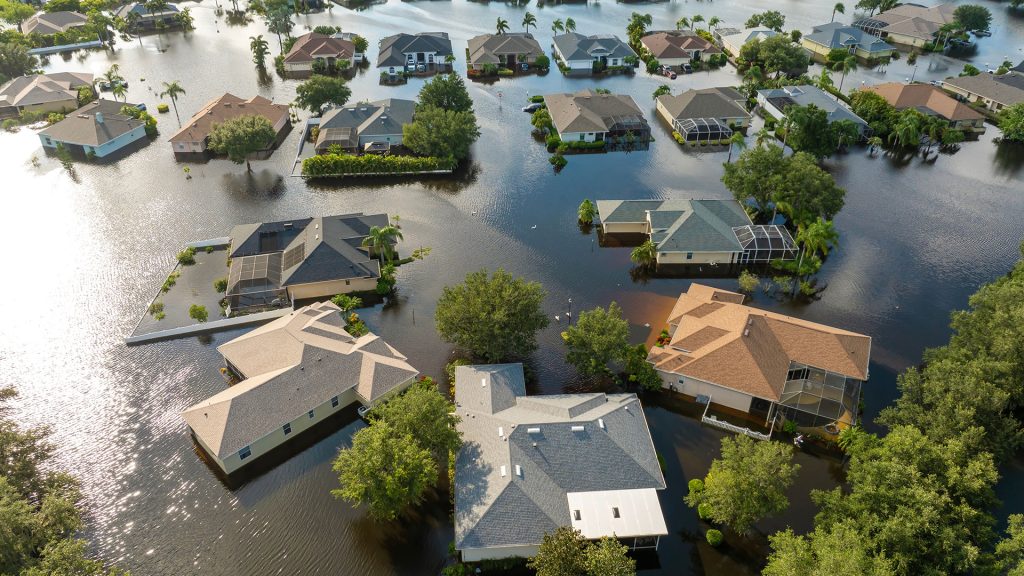
The financial reality of flood damage in the United States reveals a troubling gap between destruction and recovery resources. Property owners assume flood insurance gap will make them whole after flooding events, yet the numbers tell a different story—one where the majority of flood losses fall squarely on homeowners, businesses, and communities without adequate protection. As winter 2025-2026 brings La Niña conditions and elevated flood risks to northern states, understanding this protection gap becomes essential for anyone with property to protect.
Research from the Federal Reserve Bank of New York quantifies the scope of America’s flood insurance problem. Between 2010 and 2023, direct property damage from flooding across the United States totaled nearly 144 billion dollars. During that same period, insurance payments from the National Flood Insurance Program covered approximately 50 billion dollars—just 35 percent of the documented losses. The remaining 94 billion dollars in uninsured damage fell on property owners, many of whom had no path to financial recovery beyond depleted savings, borrowed funds, or federal disaster assistance that averages a fraction of actual losses.
The Insurance Mandate’s Limited Reach
The National Flood Insurance Program operates on the assumption that properties in designated flood zones carry mandatory coverage when mortgaged through government-backed lenders. This requirement covers roughly five percent of residential properties nationwide—those located within FEMA’s 100-year flood zones where major flooding carries at least a one percent annual probability. The mandate creates a baseline of protection, but its limitations become apparent when examining where flood damage actually occurs.
Approximately 60 percent of properties located within 100-year flood zones sit more than ten miles from any coastline, contradicting common assumptions that flood risk concentrates exclusively in coastal and riverine areas. More problematic for property owners, flood damage increasingly strikes outside designated hazard zones where insurance requirements don’t apply. FEMA’s own data indicates that more than one-third of flood insurance claims originate from properties outside high-risk flood areas—locations where owners often assume they face minimal flooding threats and carry no coverage.
The disconnect between flood zone designations and actual flood occurrence creates a false sense of security for millions of property owners. Since 1996, flooding has affected 99 percent of United States counties, yet insurance take-up rates outside mandated zones remain extremely low. Properties beyond 100-year flood zone boundaries are 15 percentage points less likely to carry flood insurance even when controlling for actual flood risk levels, according to Federal Reserve analysis. This behavioral gap leaves the majority of American properties unprotected against an increasingly common natural disaster.
The True Cost of Being Uninsured
When flooding strikes uninsured properties, owners face the full burden of recovery costs with limited options. FEMA disaster assistance, often assumed to provide substantial relief, averages approximately 3,000 dollars per household—a figure that barely covers immediate emergency expenses, let alone structural repairs or content replacement. Compare this to the average National Flood Insurance Program claim payout of approximately 66,000 dollars, and the protection gap becomes starkly apparent.
The disparity matters because flood damage costs accumulate quickly. FEMA estimates that just one inch of floodwater inside a structure can cause up to 25,000 dollars in damage. Basement flooding, foundation compromise, mold remediation, electrical system replacement, and content losses compound into figures that devastate household finances. For the 65 percent of flood damage falling outside insurance coverage nationally, these costs translate into depleted retirement accounts, second mortgages, delayed educations, and in worst cases, property abandonment.
The financial strain extends beyond individual property owners to affect entire communities. Tax bases erode when properties remain damaged or abandoned. Small businesses that anchor local economies may never reopen after flood losses exceed their financial reserves. The community-wide impacts of uninsured flooding create cascading effects that persist for years after floodwaters recede, as explored in [La Niña Winter 2025-2026: NOAA Forecasts Flooding Rains as Northern States Brace for Wet Season Ahead]—where the current La Niña pattern threatens to amplify these financial vulnerabilities across northern regions.
Rising Costs and Declining Coverage
The flood insurance market faces structural challenges that compound the protection gap. From 2009 to 2023, average annual flood insurance premiums for single-family homes increased by 82 percent—an average annual growth rate of approximately 4.4 percent that outpaces general inflation. FEMA’s Risk Rating 2.0 methodology, fully implemented in 2023, bases premiums on individual property risk factors rather than simple flood zone classifications, resulting in substantial premium increases for many policyholders.
Simultaneously, flood insurance coverage has contracted. The National Flood Insurance Program recorded nearly 900,000 fewer active policies in 2023 compared to 2009—a 16 percent decline during a period when flood events became more frequent and damaging. Rising premiums push cost-conscious property owners to drop coverage, leaving them exposed precisely as flood risks intensify. The dynamic creates a widening protection gap where properties most vulnerable to flooding become least likely to carry insurance.
The 2024 hurricane season illustrated these dynamics with devastating clarity. Hurricanes Helene and Milton generated more than 78,000 combined flood insurance claims totaling over 5.2 billion dollars in payouts—sufficient to require FEMA to borrow 2 billion dollars from the U.S. Treasury to meet claim obligations. These massive insured losses represent only the portion of damage affecting properties with coverage; total economic damage from these events extended far higher when accounting for uninsured properties.
Self-Reliance as Risk Management
Given the limitations of insurance protection and the expanding scope of flood risk, property owners increasingly recognize that self-reliance represents a critical component of flood preparedness. Waiting for insurance payouts or disaster assistance after flooding occurs means accepting weeks or months of damage progression—water that isn’t removed promptly leads to mold growth, structural deterioration, and escalating repair costs that no insurance policy fully covers.
Immediate water removal capability transforms flood response from passive waiting to active mitigation. Property owners equipped with transfer pumps can begin removing water within hours rather than days, limiting damage progression and reducing ultimate repair costs regardless of insurance status. This response capability proves particularly valuable for the significant population of property owners outside flood zone mandates who carry no flood coverage and cannot rely on insurance adjusters to authorize repairs.
The investment calculus favors preparedness. Quality water transfer equipment represents a fraction of the cost of a single flood damage incident, yet provides protection across unlimited future events. For commercial and agricultural operations where flood damage can threaten business viability, pumping capability represents essential infrastructure rather than optional equipment. Construction contractors facing unpredictable weather conditions increasingly view dewatering capacity as standard jobsite equipment, a trend examined in [Construction Sites Face Rising Dewatering Challenges as Weather Extremes Intensify].
Practical Steps for Property Protection
Property owners seeking to close their personal protection gap should begin with honest risk assessment. FEMA flood maps provide starting points but don’t capture all flooding scenarios—properties outside designated zones flood regularly, and changing precipitation patterns create new vulnerabilities in areas with limited flood history. Local knowledge about drainage patterns, historical high-water marks, and upstream development provides context that official maps may lack.
Physical flood mitigation measures deserve attention regardless of insurance status. Improving drainage around structures, installing sump pumps with battery backup, elevating critical utilities above potential water levels, and maintaining clear paths for water to flow away from buildings all reduce flood vulnerability. These improvements may also qualify for insurance premium reductions under FEMA’s Community Rating System, though their primary value lies in preventing damage that insurance never fully compensates.
Emergency equipment procurement should occur before flood threats materialize. Portable transfer pumps, drainage hoses, and power sources for pump operation allow immediate response when water threatens property. Testing equipment periodically ensures functionality when emergencies arrive—discovering a failed pump during active flooding compounds an already difficult situation.
Pacer Pumps: Your Partner in Water Transfer Solutions
At Pacer Pumps, we’ve been engineering reliable water transfer solutions since 1976. When flooding threatens your property, equipment, or operations, having dependable pumps ready to deploy makes the difference between minor inconvenience and major damage. Our products are built for the demanding conditions that flooding creates—from debris-laden water to extended operation requirements.
Our Products Include:
- Water Transfer Pumps – Portable, powerful pumps engineered for residential, commercial, and agricultural water transfer applications
- Self-Priming Centrifugal Pumps – Reliable performance for dewatering, irrigation, and emergency flood response
Ready to Close Your Protection Gap? Contact Pacer Pumps to discuss how our water transfer solutions can help you protect what matters most.
Works Cited
Blickle, Kristian S., et al. “Flood Risk and Flood Insurance.” Federal Reserve Bank of New York Liberty Street Economics, 7 Aug. 2025, libertystreeteconomics.newyorkfed.org/2025/08/flood-risk-and-flood-insurance/.
“Flood Insurance.” FEMA, U.S. Department of Homeland Security, www.fema.gov/flood-insurance. Accessed 24 Nov. 2025.
Related Articles
- [La Niña Winter 2025-2026: NOAA Forecasts Flooding Rains as Northern States Brace for Wet Season Ahead]
- [Construction Sites Face Rising Dewatering Challenges as Weather Extremes Intensify]