
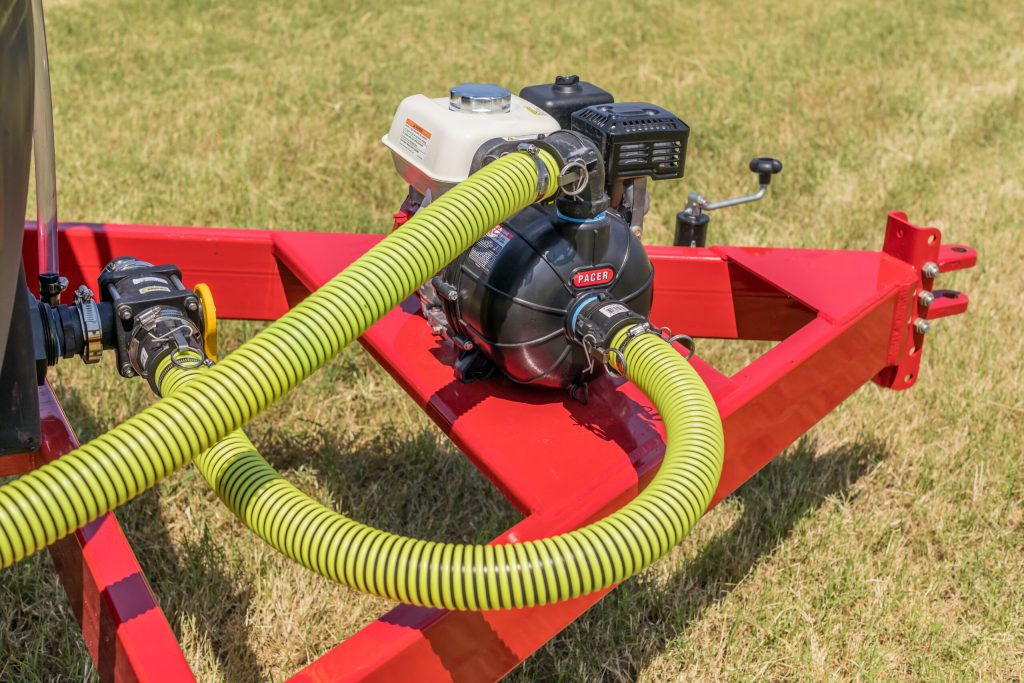
Three of the most operationally demanding fluid transfer applications on a modern commercial farm happen in rapid succession during planting and application season: loading nurse trailers with liquid fertilizer or pre-emergent herbicide, transferring pesticide concentrates into sprayer tanks, and refueling large machinery at field edges hours and miles from any fixed fueling infrastructure. Each of these operations demands reliable pump performance, each involves chemically aggressive or regulated fluids, and each carries real consequences when pump equipment fails at the wrong moment in a compressed agricultural calendar.
The regulatory environment surrounding these applications has also intensified. EPA’s 2024 implementation of strengthened Application Exclusion Zone requirements under the Worker Protection Standard signaled continued federal focus on the conditions under which agricultural pesticides are handled, transferred, and applied. These are not abstract compliance considerations for commercial producers — they define the operational protocols that govern how every pesticide transfer event is supposed to be conducted on a farm.
Nurse Trailers: Mobile Chemical Delivery at the Point of Application
Nurse trailers are the mobile chemical logistics platform of large-scale row crop production. A single nurse trailer operation may move thousands of gallons of liquid nitrogen fertilizer, herbicide concentrate, or mixed tank loads per day during application windows that last only days before weather or crop stage closes them. The pump moving product from the nurse trailer into the application equipment is transferring chemically aggressive fluids under time pressure, in field conditions, without the infrastructure support of a fixed loading facility.
Liquid nitrogen fertilizers — primarily urea ammonium nitrate solutions — are highly corrosive to ferrous metals. Herbicide concentrates, particularly glyphosate, dicamba, and 2,4-D-based formulations, carry surfactant packages that attack elastomer seals and accelerate corrosion in aluminum and brass pump components. Adjuvant oils added to tank mixes introduce additional solvent chemistry that degrades seal materials over repeated cycles. The pump serving a nurse trailer application is not making a single transfer — it is making dozens or hundreds of transfers through a single growing season, with cumulative exposure that builds material failure risk with every cycle.
For an overview of how these chemical transfer demands fit within the full spectrum of agricultural pump applications, including livestock watering, drainage, and irrigation, see Ag Pumps: The Complete Guide to Agricultural Pump Applications for Modern Farms in 2026.
Thermoplastic pump construction eliminates the corrosion failure pathway by removing metal from the equation. Thermoplastic housings and impellers do not corrode when exposed to liquid fertilizers, herbicide concentrates, or adjuvant mixtures. Seal formulations matched to agricultural chemical compatibility maintain integrity across the high-cycle transfer environment that nurse trailer operations create. The result is a pump platform that performs reliably through a full application season without the progressive degradation that metal alternatives deliver when exposed repeatedly to aggressive agricultural chemistry.
Pesticide Transfer and EPA Compliance Requirements
Under the EPA Worker Protection Standard, any person who mixes, loads, or transfers agricultural pesticides is classified as a pesticide handler and is subject to the full suite of handler protections, training requirements, and personal protective equipment mandates that the standard establishes. According to EPA’s definition of pesticide handlers under the Worker Protection Standard, these requirements apply to all agricultural establishments — farms, nurseries, greenhouses, and forests — where pesticides are used in plant production, covering any worker engaged in handling pesticide containers, operating application equipment, or transferring product between containers.
That compliance framework has direct implications for how pesticide transfer operations are conducted and documented on commercial farms. Transfer equipment must function as designed — a pump that fails during pesticide loading can create spill conditions that trigger regulatory exposure and environmental liability that vastly exceeds equipment replacement costs. The requirement for contained transfer operations, documented in EPA’s container and containment regulations for agricultural pesticides, places additional emphasis on transfer equipment that operates reliably without leaks, seal failures, or pressure-related spill events.
EPA’s rules on pesticide storage and containment requirements establish baseline standards for agricultural pesticide storage in stationary containers of 500 gallons or larger, including secondary containment and transfer equipment safeguards. While these regulations focus on storage infrastructure, they reflect the broader regulatory expectation that pesticide transfer operations are conducted with equipment appropriate for the chemical hazards involved.
Restricted-use pesticide transfers, which require certified applicator involvement, carry the highest compliance stakes. Any pump failure or containment failure during restricted-use pesticide loading creates an incident that involves regulatory notification obligations, remediation requirements, and potential enforcement action under FIFRA. Equipment selection that matches material construction to the chemical properties of the pesticide being transferred is a risk management decision as much as an operational one.
Refueling Farm Machinery in the Field
Large commercial operations running multiple pieces of equipment across hundreds or thousands of acres cannot afford to run equipment back to a central fueling location for refueling. Field-side refueling — delivering diesel to combines, tractors, sprayers, and harvest equipment at the point of operation — is standard practice on commercial operations during harvest and planting. The pump infrastructure delivering that diesel needs to work in remote locations, without fixed electrical power, at the speed required to keep expensive equipment running.
DC-powered portable pump systems, operating off a service truck’s 12-volt or 24-volt electrical system, have become the standard configuration for mobile agricultural refueling. They eliminate the need for external power sources, provide the portability to reach any field location, and deliver flow rates adequate for rapid refueling of large equipment tanks. Hydraulic-driven configurations offer an alternative for operations where a tractor is available as a power source and DC power is not.
The same considerations of material durability that apply to chemical transfer apply, in a different register, to diesel fuel transfer. Biodiesel blends — now common in agricultural diesel supply chains as renewable fuel mandates expand — are more chemically aggressive toward certain seal materials than straight petroleum diesel. Pump platforms specified for straight diesel may experience accelerated seal degradation when regularly handling B20 or higher biodiesel blends. Thermoplastic construction and chemical-compatible seal formulations address biodiesel chemistry in the same way they address agricultural chemical compatibility.
The livestock watering and drainage applications that round out the full range of ag pump requirements on a modern operation are examined in Ag Pumps for Livestock Watering, Field Drainage, and Ponded Field Recovery in 2026.
Pacer Pumps: Built for Nurse Trailers, Chemical Transfer, and Field Refueling
Pacer Pumps has engineered thermoplastic transfer pumps for agricultural chemical and diesel transfer applications for 52 years. Corrosion-resistant construction handles liquid fertilizers, herbicide concentrates, pesticide formulations, and biodiesel blends without the material degradation that metal pumps deliver over repeated agricultural use cycles. Multiple driver options — electric, gasoline, and hydraulic — provide the field flexibility that nurse trailer and mobile refueling operations demand.
Our Products Include:
- Ag Transfer Pumps — Thermoplastic pumps engineered for fertilizer, herbicide, pesticide, and diesel transfer in agricultural applications
Ready to Upgrade Your Transfer Equipment? Contact Pacer Pumps to discuss the right pump configuration for your nurse trailer, pesticide transfer, and field refueling needs.
Works Cited
“Definition of a Pesticide Handler under the Worker Protection Standard.” U.S. Environmental Protection Agency, www.epa.gov/pesticide-worker-safety/definition-pesticide-handler-under-worker-protection-standard. Accessed 19 Feb. 2026.
“Requirements for Pesticide Storage.” U.S. Environmental Protection Agency, www.epa.gov/pesticide-worker-safety/requirements-pesticide-storage. Accessed 19 Feb. 2026.
Related Articles
- Ag Pumps: The Complete Guide to Agricultural Pump Applications for Modern Farms in 2026
- Ag Pumps for Livestock Watering, Field Drainage, and Ponded Field Recovery in 2026