
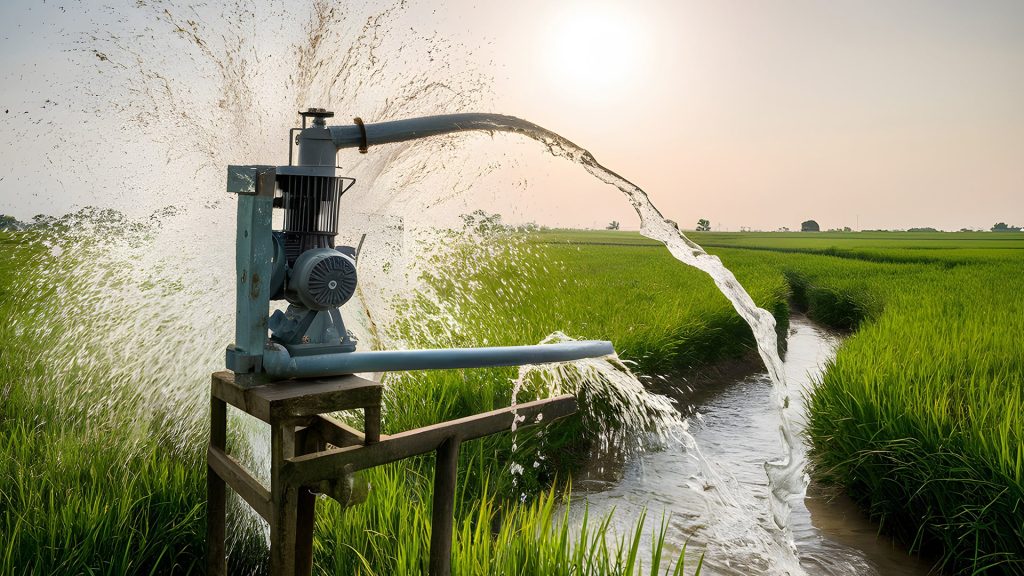
American farming runs on fluid transfer. Every acre planted, every head of livestock watered, every field drained after a spring storm, and every tractor refueled in a remote location depends on reliable pump infrastructure working exactly when it is needed. The breadth of that demand is wider than most equipment purchasers stop to consider — and the chemical complexity of the fluids being moved is greater than at any point in agricultural history.
The 2023 USDA Irrigation and Water Management Survey documented 212,714 farms managing 53.1 million irrigated acres across the country, with producers spending $3 billion on irrigation equipment and infrastructure in that single survey year. That number reflects only irrigation-specific investment. It does not capture the pump infrastructure required for chemical transfer, livestock watering, drainage management, or field machinery refueling — all of which place equally demanding requirements on the pumps involved. According to the USDA Economic Research Service’s irrigation and water use data, irrigation alone accounts for 47 percent of the nation’s total freshwater withdrawals, underscoring how central water movement is to the entire agricultural enterprise.
What that investment picture often obscures is the material challenge sitting underneath it. Agricultural fluid transfer is not a single problem. It is four or five distinct problems with different fluid chemistries, different regulatory environments, different power availability conditions, and different failure consequences — all occurring on the same operation, often managed by the same equipment budget.
The Corrosion Problem Across Agricultural Fluid Types
Modern agricultural chemicals are designed to be chemically active. That is the point. Liquid nitrogen fertilizers, herbicide concentrates, pesticide formulations, and adjuvant mixtures are formulated to penetrate plant tissue, move through soil profiles, and interact with biological systems. Those same chemical properties make them aggressive toward the metal components in pump systems that were not engineered with that chemistry in mind.
Liquid nitrogen fertilizers — including urea ammonium nitrate solutions and anhydrous ammonia — are highly corrosive to ferrous metals and certain aluminum alloys. Herbicide concentrates, particularly glyphosate-based and dicamba-based formulations, contain surfactants and carrier compounds that attack elastomer seals and accelerate metal oxidation over repeated transfer cycles. Pesticide emulsifiable concentrates carry petroleum-based carrier solvents that degrade seals and corrode brass and copper components. The result, in metal pump platforms, is a predictable failure cycle: seal degradation, corrosion-induced housing damage, and accelerating performance loss that can compromise an entire application season if the pump fails during a critical transfer window.
The operator managing nurse trailers, loading pesticides into application equipment, and fueling a combine at a field edge on the same day needs pump infrastructure that handles all of those fluid types without material compatibility conflicts creating cascading failures. Thermoplastic construction addresses this challenge by removing the corrosion pathway entirely. Thermoplastic pump housings, impellers, and seal components do not participate in the electrochemical processes that agricultural chemicals drive in metal equipment. They maintain structural and functional integrity across repeated cycles of corrosive chemical contact, providing a single durable platform for the full range of agricultural fluid transfer operations.
The specific compliance and operational demands of nurse trailer loading, pesticide transfer, and farm machinery refueling are examined in depth in Ag Pumps for Nurse Trailers, Pesticide Transfer, and Refueling Farm Machinery in 2026.
Livestock Watering and the Water Quality Dimension
Livestock operations place a different set of demands on ag pump infrastructure. Cattle, hogs, and poultry require reliable, clean water supply daily, and the volumes involved are substantial. A mature dairy cow in active production requires 35 to 50 gallons of water per day depending on ambient temperature and milk output. A 500-head beef cattle operation needs continuous, distributed access to water across pasture systems — which means moving clean water from storage, wells, or water lines to troughs distributed across grazing areas, often at distances from any fixed power infrastructure.
The pump platform serving livestock watering needs to move clean water reliably without introducing contamination from metal component degradation. Thermoplastic construction eliminates the rust and oxidation risk that metal pumps introduce when handling water intended for animal consumption. Multiple driver options — electric for permanent barn and holding area installations, hydraulic-driven for remote pasture watering systems that tap tractor hydraulics — enable water delivery wherever the animals are rather than requiring animals to travel to fixed infrastructure.
Field Drainage and Ponded Field Recovery
Spring planting windows and post-storm field recovery represent time-critical fluid transfer challenges where pump reliability translates directly into dollars. Saturated root zones damage germinating crops, prevent planters and sprayers from entering fields, and delay schedules in ways that cascade through an entire growing season. Ponded surface water on flat fields after heavy rainfall events requires active pumping to remove before equipment can operate. A pump failure during a critical drainage period — when every hour of standing water extends the recovery timeline — carries consequences that far exceed the cost of the pump itself.
The drainage and ponded field applications the USDA’s National Agricultural Statistics Service tracks in the 2023 Irrigation and Water Management Survey reflect a system-level reality: productive farming depends on active water management, not just in dry conditions but in wet ones as well. The pump infrastructure supporting drainage is as operationally critical as the equipment supporting irrigation or chemical application.
Driver Flexibility and the Multi-Operation Farm
Few modern farm operations can be served by a single power configuration. Fixed electrical infrastructure is available near barns, shops, and processing buildings. Field edges and remote locations may have nothing but a tractor with a running hydraulic system. Mobile nurse trailers and tender trucks need portable pump platforms that operate independently of any fixed power source. The ag pump platform that requires operators to maintain separate equipment inventories for each power configuration — electric, gasoline, hydraulic — creates unnecessary cost and logistical complexity.
Thermoplastic pumps offered with genuine driver flexibility across electric, gasoline, and hydraulic configurations solve this problem at the equipment specification level. The same corrosion-resistant material specification and the same durable construction that handles liquid fertilizers in a nurse trailer application also handles diesel fuel at a field-side refueling station and clean water at a remote livestock trough — paired with the driver configuration that matches the available power source at each location.
The livestock watering, drainage, and ponded field recovery applications that complete the full picture of agricultural pump requirements are examined in Ag Pumps for Livestock Watering, Field Drainage, and Ponded Field Recovery in 2026.
Pacer Pumps: Built for Every Agricultural Fluid Transfer Challenge
Pacer Pumps has served agricultural producers for 52 years with thermoplastic transfer pump solutions engineered for the full range of farm fluid transfer demands. Corrosion-resistant construction handles fertilizers, herbicides, pesticides, diesel, and clean water without the material compatibility failures that metal pumps deliver. Multiple driver options — electric, gasoline, and hydraulic — match power source to operational environment, from barn installations to remote pasture watering to field-edge refueling.
Our Products Include:
- Ag Transfer Pumps — Thermoplastic ag pumps with multiple driver options for fertilizer, pesticide, water, and diesel transfer applications
Ready to Equip Your Operation? Contact Pacer Pumps to discuss the right pump configuration for your agricultural operation.
Works Cited
“Irrigation and Water Use.” Economic Research Service, U.S. Department of Agriculture, www.ers.usda.gov/topics/farm-practices-management/irrigation-water-use/. Accessed 19 Feb. 2026.
“2023 Irrigation and Water Management Data Now Available.” National Agricultural Statistics Service, U.S. Department of Agriculture, 31 Oct. 2024, www.nass.usda.gov/Newsroom/2024/10-31-2024.php. Accessed 19 Feb. 2026.
Related Articles
- Ag Pumps for Nurse Trailers, Pesticide Transfer, and Refueling Farm Machinery in 2026
- Ag Pumps for Livestock Watering, Field Drainage, and Ponded Field Recovery in 2026